Intake Friction Cost Calculator
Estimate the potential labor cost, capacity consumption, and delivery delay created when unclear requests require clarification and rework before delivery.
Lean Intake Analysis · Compass Software
LIA Compass™ helps organizations clarify business needs, evaluate readiness, align stakeholders, and document governance decisions before work enters delivery.
Two complementary tools help leaders make the upstream problem visible before committing delivery capacity: first quantify potential intake friction, then assess whether the work is ready to proceed.
Estimate the potential labor cost, capacity consumption, and delivery delay created when unclear requests require clarification and rework before delivery.
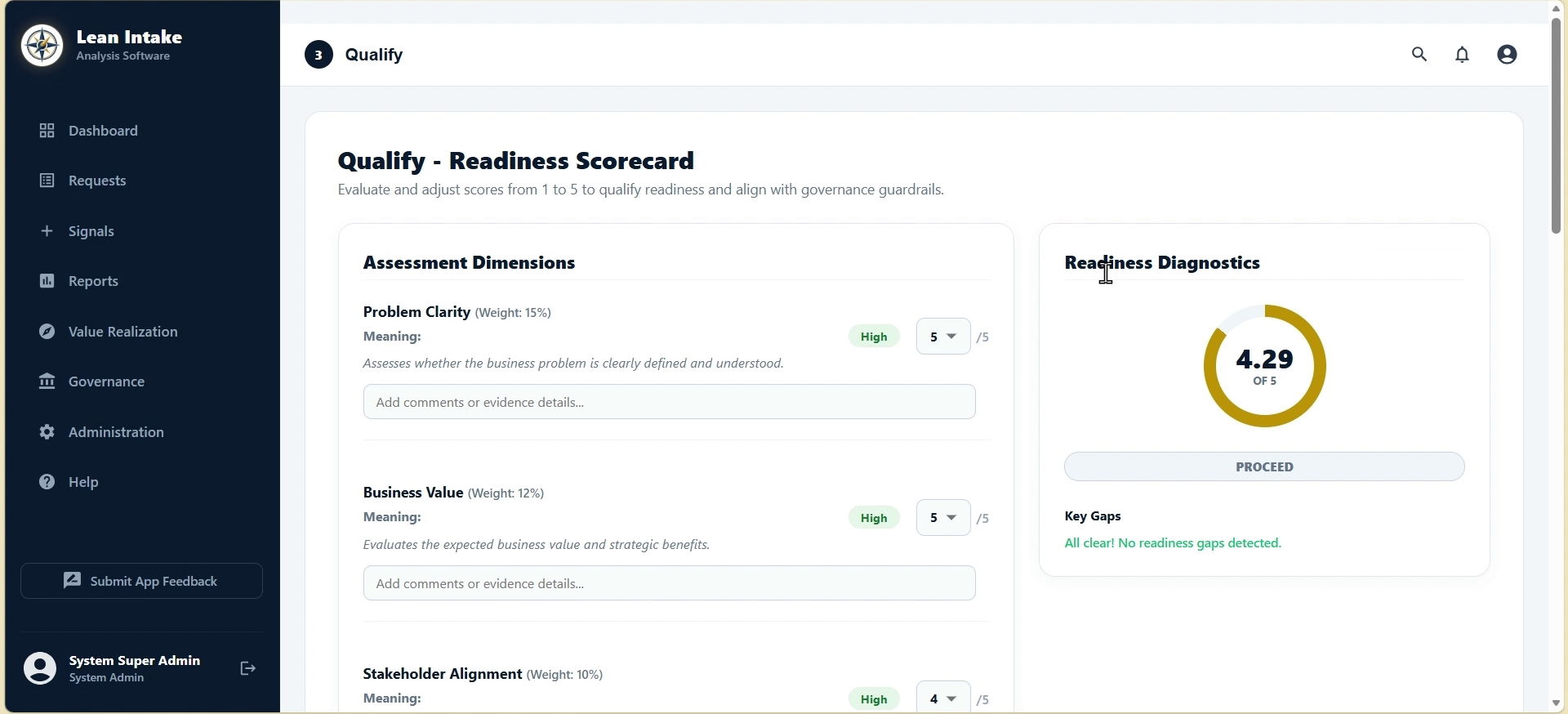
Evaluate whether requests are sufficiently clear, aligned, governed, and decision-ready before teams commit budget and capacity to execution.
The expensive failures rarely come from poor execution. They come from unclear intake — requests that were never pressure-tested for clarity, readiness, or organizational support before resources were spent.
initiatives that stall trace back to ambiguity at intake, not delivery capacity.
Work begins from a one-line ask. Scope, intent, and success criteria are interpreted differently by every team that touches it.
Sponsors, operators, and delivery teams hold conflicting assumptions that surface late — usually after budget is committed.
Decisions are made in hallways and threads, leaving no defensible record of why an initiative was approved, paused, or reshaped.
LIA Compass™ — Lean Intake Analysis Compass Software — gives intake, governance, and delivery leaders one shared instrument for deciding what enters delivery, on what terms, and with whose support.
A guided intake converts a vague ask into a structured, testable problem statement with explicit intent and success criteria.
Every request is evaluated against consistent readiness dimensions — producing a defensible Go, Conditional Go, or Hold.
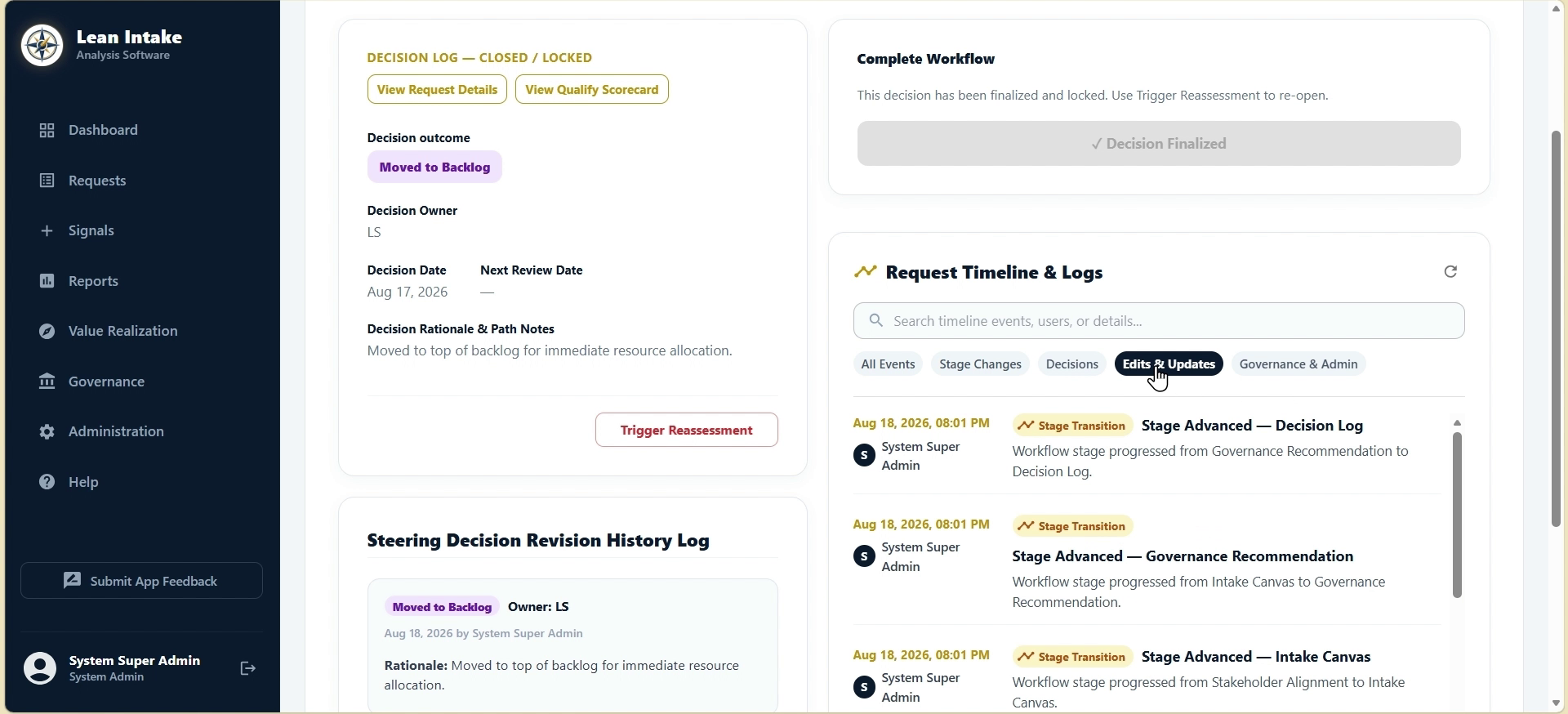
The reasoning, conditions, and accountable owners are captured as a durable decision record — not a forgotten thread.
Each stage builds the evidence the next one needs — so the final recommendation is defensible, not improvised.
Capture the request through a guided intake that forces clarity on intent, scope, constraints, and the outcome being pursued.
Score the request across consistent dimensions — clarity, data, alignment, and governance fit — for an objective readiness signal.
Surface the people who must agree, capture their positions, and resolve conflicting assumptions before work is committed.
Produce a decision-ready recommendation — Go, Conditional Go, or Hold — with the conditions and owners attached.
Lock the decision into a durable record, export a PDF assessment, and track value realization against the original intent.
A guided framework that converts a loose request into a complete, testable problem statement.
Consistent, weighted scoring across clarity, data, alignment, and governance fit.
Map decision-makers, capture positions, and reconcile assumptions before commitment.
Decision-ready Go / Conditional Go / Hold outcomes with conditions and accountable owners.
A durable, auditable history of what was decided, by whom, and on what evidence.
Export an executive-ready assessment for sponsors, committees, and audit.
A portfolio view of intake volume, readiness distribution, and decision throughput.
Measure delivered outcomes against the intent captured at intake.

Bring a single intake standard to every incoming request and defend portfolio decisions with evidence.
Replace informal approvals with auditable decision records and consistent readiness criteria.
Translate a business need into a clear, supported recommendation before requesting resources.
Accept only work that is clarified, scored, and aligned — protecting teams from ambiguous scope.
LIA Compass™ is available for guided product walkthroughs and structured pilots. Pilot teams bring real requests; we configure the readiness model and governance criteria to your environment.

Catch unclear or unsupported requests at intake — before they consume delivery capacity and budget.
Replace circular debate with a consistent readiness signal and a clear, defensible recommendation.
Every approval, condition, and owner is captured — ready for audit, review, and onboarding.
Track delivered outcomes against the original intent so governance learns from every decision.
A regional services firm receives a one-line request to “modernize customer onboarding.” Rather than opening a project, the intake team runs it through LIA Compass™.
Structured intake exposes two competing definitions of “onboarding.” Readiness scoring flags low data availability. Alignment captures nine stakeholders and two unresolved risks. The result: a Conditional Go — approved once a data owner is named — recorded as a decision and exported as a PDF assessment for the steering committee.
“Modernize onboarding.”
Scored 74 / 100
9 stakeholders, 2 risks
Conditional Go